


18 Sep Spring Fitness Reset in Richmond: How Indoor Cycling Helps You Get Back on Track
Winter has a way of dismantling our routines. One day you’re hitting the gym three times a week, and somewhere between the early sunsets and the extra layers of clothing, you’ve turned into someone who “will start again on Monday.”
You’re not imagining it, either; research shows moderate-to-vigorous physical activity drops by as much as 23% during winter months compared to spring and summer, while sedentary time creeps up. Our bodies and brains basically hibernate a little.
Then spring shows up, the days get longer, and suddenly you feel that familiar itch to reset. That’s psychology at work.
The “Fresh Start Effect”
Behavioural scientists call it the Fresh Start Effect: the idea that meaningful calendar markers (a new year, a new month, a new season) let us mentally separate from our past selves. Winter-you skipped the gym for eight weeks straight; Spring- you get a clean slate.
Gym visits jump by around 14% at the start of a new week, 33% at the start of a new month, and 47% at the start of a new year. Framing your comeback around a landmark like “the first day of spring” rather than some random Tuesday makes you more likely to follow through.
Motivation gets you through the door; however, it doesn’t keep you coming back. That’s the harder part.
Why do Spring resets fizzle out?
About half of people who intend to start exercising again never turn that intention into a real habit. This is often called the intention-behaviour gap, and it’s less about willpower and more about friction.
A huge chunk of that friction has a name: gymtimidation. It’s that specific flavour of anxiety you feel walking into a gym after time away; not knowing which machine does what, worrying someone’s watching you fumble with a barbell, or just not having a clue how to structure a workout. And it’s incredibly common:
- Roughly 47-50% of gym-goers report feeling intimidated at the gym
- 72% of women and 50% of men say unfamiliar equipment is a major stressor
- About a third of people (33–34%) say they’re anxious about working out in front of others
- Nearly a quarter to a third cite simply not knowing how to build an effective workout
Put someone with zero equipment knowledge into a wide-open gym floor full of confident regulars, and it’s no wonder most beginners abandon ship within two or three weeks. If you want your spring reset to actually stick, you need something that removes that guesswork entirely.
Why indoor cycling solves the beginner problem
Indoor cycling classes work so well for people rebuilding fitness because they strip out almost every barrier that usually makes people quit:
- There’s nothing to figure out
You clip in, the instructor tells you when to sit, stand, sprint, or recover, and the music does the rest. No wondering if you’re “doing it right.” That single feature eliminates the equipment-confusion problem that trips up most intimidated exercisers.
- It’s low-impact
Because the saddle supports your body weight the entire time, cycling is a non-weight-bearing, closed-chain movement. There’s minimal shear force on your knees and hips compared to something like running, which puts 2.5 to 3 times your body weight through your joints with every stride. That matters a lot if you’re coming back from a sedentary winter, carrying some extra weight, or just don’t want to spend week one nursing sore knees.
- Everyone in the room is doing their own workout.
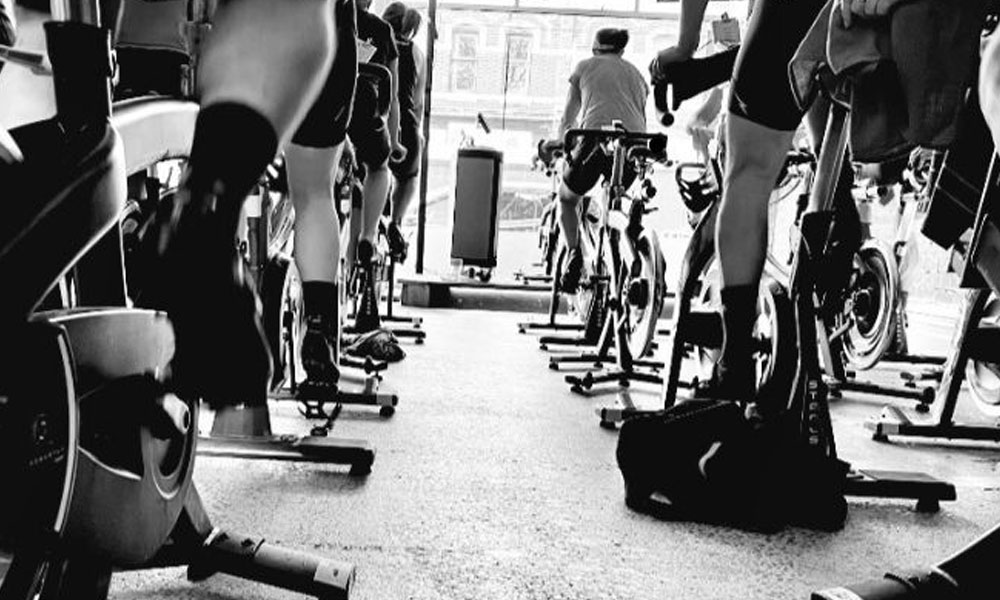
This is the underrated genius of cycling classes: the instructor sets the cadence and the vibe, but you control your own resistance knob. That means a total beginner and a seasoned rider can be pedalling next to each other, following the exact same cues, while working at completely different intensities. Nobody can tell how hard you’re actually pushing. The social comparison that fuels gym anxiety basically disappears.
- Social in the good way
Group exercise settings have been shown to reduce psychological stress compared to working out alone. A dark room, good music, and a group of people breathing hard together turn exercise into a shared experience instead of a solo grind, and that camaraderie is a big part of why cycling studios see stronger long-term attendance than typical gym memberships.
How to make it stick
Habits take time to become automatic, so the goal for the first few weeks is repetition. A few practical ways to bake that in:
- Pick your slots and book ahead. “I’ll work out sometime this week” rarely happens. “Cycling class, Tuesday and Thursday, 6:30 AM, already booked” almost always does.
- Pair it with something you enjoy. Save a favourite podcast or playlist specifically for ride days, as it gives your brain a reason to look forward to it.
- Start easier than you think you need to. A 20–30 minute beginner ride two or three times a week beats a brutal 45-minute session you dread and skip next time.
- Track something small. Logging attendance, checking your heart rate recovery, or just noting how many rides you’ve completed gives you a quick psychological win while the bigger physical changes are still catching up.
Where can you find indoor cycling classes in Richmond Melbourne?
If you’re in Melbourne and ready to put all of this into practice, Cycle Collective in Richmond is a great place to start. Our science-based studio uses power-based training and personal training cards, so every rider works at their own correct intensity/fitness level, in the same room as everyone else.
Join a supportive, community-driven atmosphere via a spot on Bridge Road that’s easy to build into your weekly routine. It ticks every box for a spring reset that lasts. Check the class timetable and book your first ride!

No Comments